February 9, 2026: The Education and Employment Research Center at Rutgers University (EERC) and the National Council for Workforce Education (NCWE) have launched Student Voices Informing Practice in Noncredit Workforce Education. This new initiative aims to understand the experiences and perspectives of community college students enrolled in noncredit workforce programs and elevate the insights of the college staff and faculty who oversee and deliver these programs.
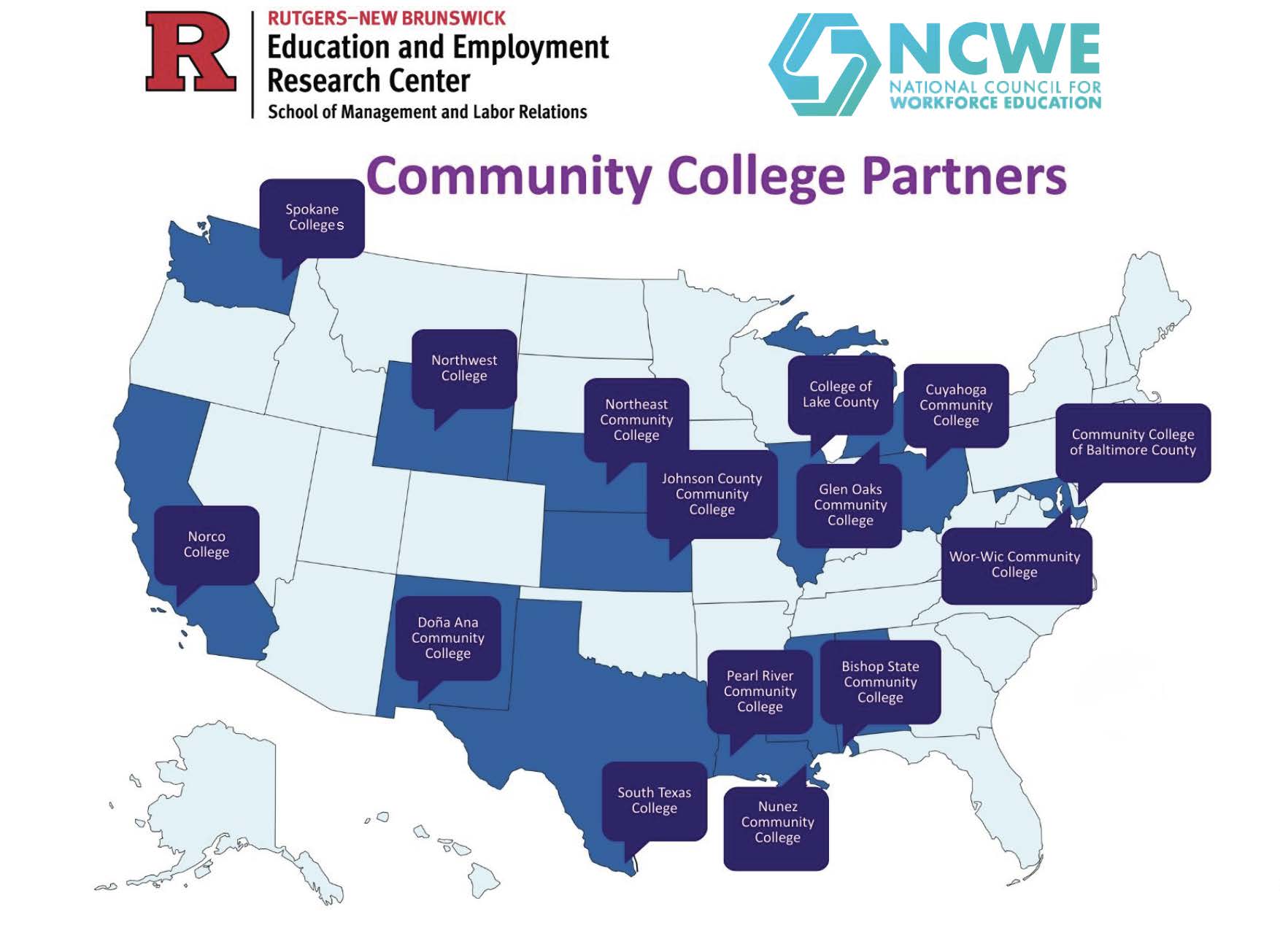
EERC and NCWE are thrilled to announce the 15 colleges selected, representing a broad range of students, programs, size, structures, geographies, and policy landscapes. Congratulations to:
- Bishop State Community College, Alabama
- College of Lake County, Illinois
- Community College of Baltimore County, Maryland
- Cuyahoga Community College (Tri-C), Ohio
- Doña Ana Community College, New Mexico
- Glen Oaks Community College, Michigan
- Johnson County Community College, Kansas
- Norco College, California
- Northeast Community College, Nebraska
- Northwest College, Wyoming
- Nunez Community College | LCTCS, Louisiana
- Pearl River Community College, Mississippi
- South Texas College, Texas
- Spokane Colleges, Washington
- Wor-Wic Community College, Maryland
This collaborative initiative will consist of research to capture the perspectives of the students, and a community of practice for peer learning among the 15 participating colleges. An important focus of the project is to connect research to practice, to ensure the experiences and insights of noncredit students and college practitioners drives the change that will improve programs and policies, learner outcomes, and Workforce Pell implementation at campuses across the country.
More About the Initiative:
The Student Voices Informing Practice in Noncredit Workforce Education initiative is designed to find out what works and what can be improved:
- What can we learn from students in noncredit workforce education that could directly inform policies and practices in their programs?
- How can we create effective dialogue among college practitioners to drive program and policy change and improve outcomes?
Noncredit programs are not new to community colleges, but recent interest in them has grown, as increasing numbers of adults seek to improve their labor market prospects with short-term and affordable programs. Yet, little is known about those who enroll in these programs, as most noncredit offerings and systems exist separately from the colleges’ credit programs and infrastructure. The expertise of college staff leading and teaching in noncredit programs is also often missing from the research, policy, and practice landscape.
This initiative is different, and will center the voices and expertise of noncredit students and college staff and faculty. The research and activities are designed to promote practice and policy improvements that drive economic opportunity for students and include:
Project Activities:
 College Surveys and Program Analysis. For each college, the research team will document the overall status of noncredit workforce education through a survey and analysis of policies, practices, and program offerings.
 Student Surveys and Interviews. Researchers will conduct a survey of students in noncredit workforce programs at each college, drawing from EERC’s prior work, to understand students’ goals, experiences, and challenges. A subset of students will be recruited for interviews.
 Interviews with College Staff. The research team will also conduct interviews with instructors, administrators, and advisors from a subset of the colleges to gather their perspectives.
 Peer Learning Convenings. The research will be complemented by peer learning convenings among college staff to reflect on the research findings and share effective practices and change opportunities. The convenings will include virtual gatherings and a final in-person convening.
For more information, contact Katherine Hughes at katherine.hughes@rutgers.edu or Kate Kinder at kkinder@ncwe.org.